Pauillac's Powerhouse: Nine Vintages of Château d'Armailhac Reveal Bordeaux at Its Finest
When I received an email about The Wine Store's vertical tasting of Château d'Armailhac, I lept at the opportunity to reserve my spot and called them immediately. Two compelling reasons drove my quick response: First, I love attending the exceptional wine tastings this store offers, and second, I have long had a particular passion for Bordeaux wines. Having recently experienced their outstanding Barolo masterclass (you can read about that tasting here), I had a strong suspicion that this would be another event to remember.
The opportunity to taste nine different vintages from the historic Château d'Armailhac held special significance for me. During my visit to Château Mouton Rothschild’s museum in 2022 (detailed in my blog post here), I had seen for myself the small glass figurine that inspired this château's wine label. However, despite knowing a good deal about the estate's history and its connection to the legendary Rothschild family, I'd only actually tried their wine once — about four years ago. This just-announced tasting offered the perfect opportunity to experience a comprehensive vertical of a château I knew well on an intellectual level but still needed to understand better via the act of tasting.
MY FIRST INTERVIEW: DISCOVERING THE WINE STORE'S PHILOSOPHY
I arrived early for the tasting because Keith Lofton, the store's general manager, had graciously agreed to allow me to conduct an interview with him — something I’d never before attempted for this blog! I wanted to learn more about Keith and The Wine Store, which is currently my favorite wine shop in the Atlanta area.
When I asked Keith what makes this store different from those of his competitors, he emphasized its unmatched selection and the expertise of the staff. "Everybody that works here has been here at least ten years,” Keith explained. “I've been in the industry over 32 years now and they've had extensive experience and training in the industry (as well)." This depth of knowledge shows in The Wine Store’s impressive selection of European imports—particularly from Bordeaux, Burgundy, Barolo, and Barbaresco.
"We're sort of a destination store for a lot of collectors around the state, and even out of state. We have clients that seek us out," Keith noted with pride. What truly sets them apart, he explained, is their educational approach to wine tastings. "I think our tastings are a little unique in that we focus on an educational aspect of the region we're (featuring), as well as talking about soil types, the producers themselves and the history of the area. I think that's what sort of sets us apart from a lot of our competition."
Keith began his wine journey during his Coast Guard days, when he lived with two chefs who hosted elaborate Sunday wine dinners. "I wasn't a wine drinker, but people would bring all these great wines, and eventually one of the wines just turned on a light bulb for me," he recalled. The very next day, he found himself at the library, checking out every wine book he could find. Thus began a lifelong passion.
His expertise now combines self-education with much more formal and impressive credentials: "I'm a certified wine educator, certified specialist of wine from the Society of Wine Educators, and I'm a registered sommelier through the Court of Master Sommeliers," he explained. However, he values his practical experience most: "I'm a little bit more proud of my time in the industry, which has taught me a lot more than any of the certifications or any of the books..."
When I inquired about his favorite wine regions, Keith mentioned his love for what he calls the "Killer B’s"—Barolo and Barbaresco— along with Bordeaux and Brunello. His favorite region to visit? "Definitely Piedmont in Italy,” he answered, seemingly instinctively. “The hospitality of the Italian people is such that they are just so welcoming and inviting. They bring you into their home, (and) they'll serve you lunch even when you don't have a lunch appointment." This appreciation for wines that boast their own individual stories clearly informs how The Wine Store not only selects but then presents its offerings. They are always striving to connect each wine to its own special history, place, and winemakers.
THE WINE STORE OR THE WINE SCHOOL?
This tasting took place in a cozy, purpose-built room next to Keith’s main store in a space called Bin 75. This intimate setting, formerly used as a restaurant and wine bar by NFL star Chris Hinton, has now been transformed into a private event space that’s geared for wine tastings. The room featured several elegantly set tables with proper stemware, tasting sheets, and the pens participants would need for taking notes on their experiences.
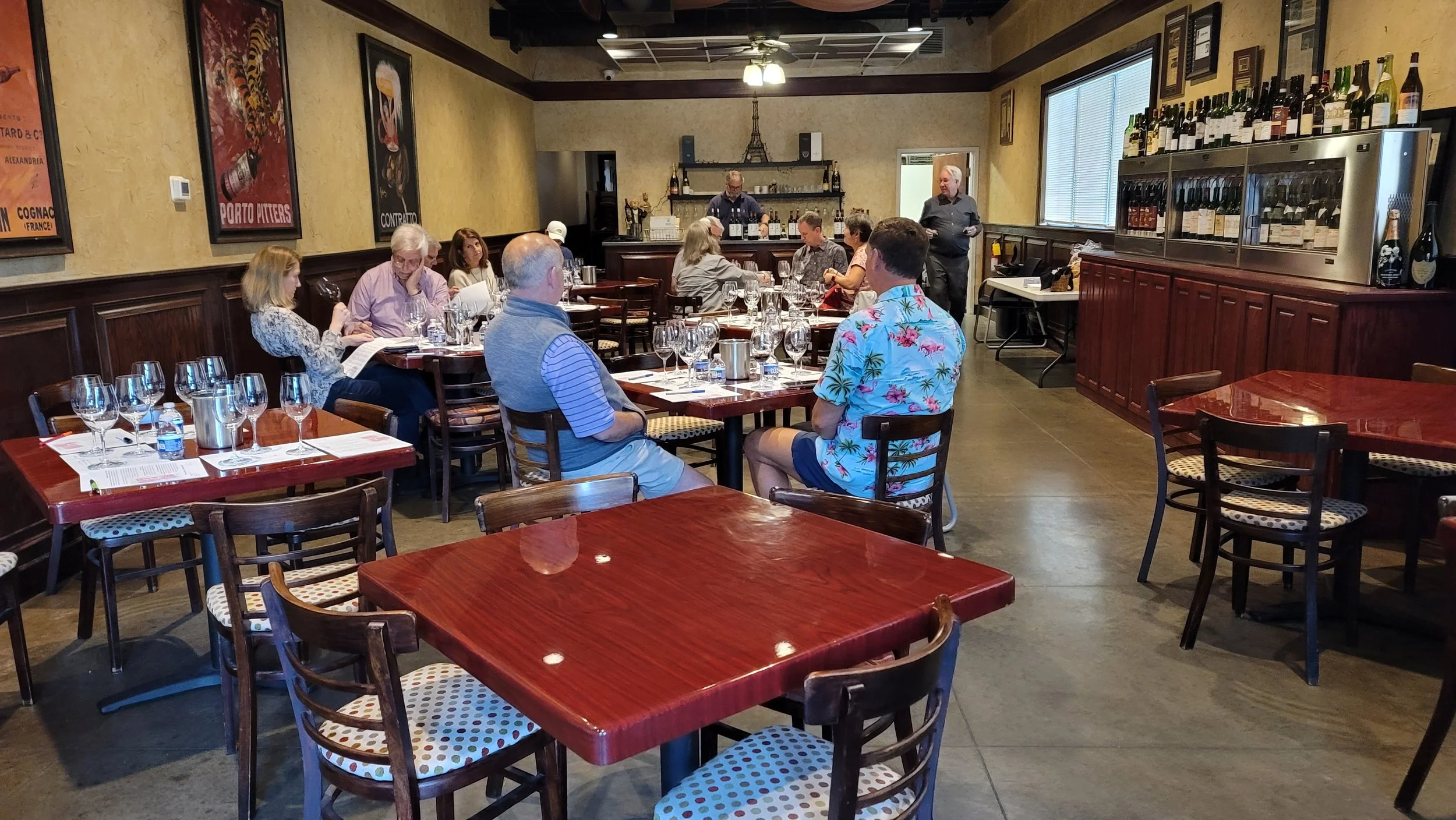

Just as one would hope, a generous charcuterie board graced a nearby side table, featuring an array of cured meats, cheeses, and accompaniments — ideal for cleansing one’s palate between tastings and for giving context to how these wines might pair with different types of food. This thoughtful touch allowed us all to experience in real time how each wine would evolve if placed alongside complementary flavors.

A picture-perfect environment for appreciating fine wine!
THE TASTING BEGINS: HISTORY AND HERITAGE
As other guests arrived, Keith welcomed everyone and then offered us all a fascinating historical overview of Bordeaux. He explained in detail how the region has produced wine since Roman times, but noted that much of the Médoc —where Pauillac, St. Julien, St. Estèphe, and Margaux are located— was —get this— actually underwater until the 15th and 16th centuries! I was genuinely surprised by this fact; despite considering myself quite knowledgeable about Bordeaux and having visited the region personally, I had never heard this particular historical detail. It reminded me just how valuable these educational tastings at The Wine Store truly are. There's always something new to learn, even for folks well-versed in wine.
Keith highlighted the unique growing conditions in Bordeaux, emphasizing that French law prohibits irrigation. "In France, you cannot change the characteristic or terroir of the vineyard sites through any means other than what mother nature gives you," he explained. This restriction has led to high-density plantings —around 8,000 plants per acre at d'Armailhac— forcing the vine roots to grow very deeply in search of water. Sometimes they are found to extend 20-30 feet below the surface!
Watch the video below to hear Keith's complete explanation of Bordeaux's fascinating geological history and the strict French regulations that shape these legendary wines. His storytelling brings the region's unique terroir to life in a way that written words alone simply cannot capture.
Rick Caudle from Savannah Distributing then took over to share the specific history of Château d'Armailhac. In the 16th century, the d'Armailhacq brothers were boat captains by trade, and they purchased one of the largest portions of northern Pauillac. The property changed hands several times over the centuries until 1934, when it was purchased by the famed Baron Philippe de Rothschild, who owned neighboring Château Mouton Rothschild. From that point on, the estate underwent several name changes before ultimately reverting to Château d'Armailhac in 1989 after the death of Baron Philippe, when his daughter Philippine decided to honor its original heritage.
Today, the vineyard is planted with 53% Cabernet Sauvignon, 36% Merlot, 8% Cabernet Franc and 2% Petit Verdot. What makes d'Armailhac truly special is the age of its vines — they average 50 years old, with some plantings dating back over 130 years! Rick noted that they have the oldest Cabernet Franc vines in the entire Médoc.
in the video below, Rick Caudle shares the fascinating ownership history of Château d'Armailhac and explains how their ancient vines contribute to the estate's distinctive character under the Rothschild family’s stewardship.
FLIGHT ONE: A QUARTER OF A CENTURY IN A BOTTLE
Once this rich historical context had been firmly established, we began our collective tasting journey with the first flight of wines: 2000 Château d'Armailhac, 2005 Château d'Armailhac, and 2009 Château d'Armailhac.

The 2000 Château d'Armailhac, now 24 years old, showed a brownish-red color with slight bricking around the rim. On the nose, I detected earthy aromas and black fruit. The wine was quite balanced —I couldn't detect the alcohol at all— with a musty quality and light tannins. I scored it 93 points, believing it had perhaps ten more years of life ahead. This vintage was my second favorite of the first flight.
"Take a look at the color," Keith advised us. "If you tilt these wines away from you, the 2000 has that nice brick-y kind of rim to it. The 2005 and 2009 are almost solid. The color is solid all the way throughout. And that just leads me to believe that they're going to be a lot more youthful, a lot more rugged in style than the 2000 will be."
The 2005 Château d'Armailhac displayed a more youthful color with no bricking. It offered even better balance than the 2000, though I could more prominently taste the alcohol. It had less mustiness, rich tannins and distinctive notes of coffee. Despite its 19 years, it was still drinking quite young, and I saw significant upside with more cellar time. So, I scored this wine 94 points, making it my favorite of the flight, and made sure to purchase some for my own cellar.
The 2009 Château d'Armailhac presented a dark red color and a nose dominated by red fruit. As expected for a younger wine, it showed much more primary fruit on the palate than either the 2000 or 2005. It had low alcohol presence on the palate, medium tannins, and a very dry finish. Notes of pencil lead were prominent, and I thought it would pair beautifully with food. I scored it 93 points, noting its excellent aging potential.
Interestingly, the 2009 was the only vintage of d'Armailhac I had ever tried before this tasting. It was remarkable to revisit it four years later and find that I scored it exactly the same today as I did back then — 93 points. The consistency of both the wine and my own palate was reassuring!
"The ‘09s are super muscular for d'Armailhac," Rick observed. "They've got a lot of richness and a lot of depth, (it’s a) common thread you'll get throughout that elegant finish. You still get this nice velvety sort of finish on the palate that drinks real easy. But here you find much more prevalence of the fruit in the nose."

FLIGHT TWO: CONTRASTING VINTAGES
Our second flight included the 2010 Château d'Armailhac, 2012 Château d'Armailhac, and 2015 Château d'Armailhac.
I was immediately struck by the 2010 Château d'Armailhac, as it possessed a completely different aromatic profile from the previous wines we’d sampled. Its nose featured dark fruit, particularly blueberry. On the palate, it showed less tannin than the 2009 but higher alcohol. It was the fruitiest wine of the tasting thus far, with the fruit almost completely masking the pencil lead notes I'd detected in earlier vintages. Red licorice notes and a velvety finish rounded out this exceptional wine, which I ultimately scored 94 points. The stark difference between the 2009 and 2010 —back-to-back vintages— was remarkable, and I purchased some 2010 for my cellar.
"The ‘10 is a real sweet spot," Rick enthused. "When you smell the ‘10, it has a really nice sort of raspberry, blackberry… Just big dark fruits right up front. I'm on the side of the tannins, so I love the tannins. I think they drink beautiful right now, richness, super sweet tannins… You really get them in there, but it's almost refreshing on the palette when the tannins hit you. It doesn't offend one little bit. And then (you have) this nice long, rich finish that just doesn't stop."
The 2012 Château d'Armailhac represented what Keith described as the only "outlier" vintage of the tasting. While still considered outstanding, the 2012 vintage faced challenges with Cabernet Sauvignon ripening, though Merlot, Cabernet Franc, and Petit Verdot performed excellently that year. The wine showed high acidity, earthy and herbaceous notes, and high tannin. While good, it lacked the balance of the 2010. I scored it 91 points.
"On the ‘12 I get a little more pronounced herbaceous kind of notes, little, like a bouquet gardening kind of herb… bright herbs," Rick noted. "You had some early frost that year and some frost damage in the mid years, really all throughout, especially the Médoc and parts of St. Emillion. Then you had these strange rainfalls in the early part of that growing season."
Keith added important context: "On the '12, where some people struggled a little bit with Cabernet, it was a phenomenal vintage for Merlot, Cab Franc, and Petit Verdot. They got excellent ripeness on left bank and right bank in this vintage, and those great varieties excelled. This is still a highly dominant cabernet characteristic and you might pick up some of the herbaceous kind of notes where the cabernet just did not get to that ultra lush ripeness."
The 2015 Château d'Armailhac brought us back to exceptional quality. Dark fruit and tannic structure dominated, though its youth was evident. I also saw tremendous upside potential for this wine, scored it 94 points and added it to my purchase list alongside the 2010.
"Where I notice a lot more of the ‘barrel’ kind of notes," Keith observed, "d'Armailhac is actually aged in about 1/3 new oak (brand new - replaced every single year) or they use it for the remainder. It'll be 1/3 brand new oak, so you get a lot of, like, ‘fresh oak’ tones out of the brand new wines, but then they'll use one and two-year-old oak for almost the remainder and then three, four, and five to finish out the blending process."

FLIGHT THREE: AH, THE PROMISE OF YOUTH…
Our final flight showcased the future potential of Château d'Armailhac with the 2016 Château d'Armailhac, 2019 Château d'Armailhac, and 2020 Château d'Armailhac.
The 2016 Château d'Armailhac offered red fruit on the nose with cedar and graphite notes. Super young and primary in character, it showed high tannin and acidity. I scored it 93 points, recognizing significant aging potential.
"I think between the ‘15 and ‘16, I really like the way the ‘16 is aromatically right now," Rick commented. "I think they're really showing beautiful, bright fruit. Still that nice little ‘pencil lead character’ you're gonna find in there… I think on the ‘16 it was a pretty warm vintage, so I think you're really getting some fresh tobacco; aged tobacco there as well on the nose. The palate, I think is still pretty tight."
He continued, "In my perfect world, I probably wouldn't open a bottle of this for at least ten more years. And if I did, I would certainly decant it overnight at least, because I think you're gonna see that all that midpalate complexity will finally start to open up."
The 2019 Château d'Armailhac and 2020 Château d'Armailhac marked my first taste of "Grand Vin" Bordeaux from these recent vintages. At this point in the tasting, I found it challenging to distinguish between these two extremely youthful wines. Both showed tremendous promise but were currently dominated by primary fruit and substantial tannins. I scored both 92+ points, noting that I wouldn't touch either for years without significant decanting.
"2019 vintage: Again, here you're moving into a really nice warm vintage. (There were) almost perfect conditions in ‘19, nothing that anyone complained about," Rick explained. "Very aromatic, beautiful big fruit. It's lots of black currant and (you’ll) really just wanna have a scone and enjoy this producer."
For the 2020, Rick noted: "We're in this real fluke stage in Bordeaux with lots of great vintages back-to-back. ‘20 - a really, really nice vintage. There was a little rain later in summer. I shouldn't say a little, it was actually a lot of rain later in summer, mid- to late-August, but no real effect. Beautiful September, nothing but sunshine. Spectacular final harvest across the board."

FIRST AND SECOND WINES IN BORDEAUX: WHAT’S THAT ALL ABOUT?
One concept that came up throughout the tasting that might be unfamiliar to some is the distinction between "first" and "second" wines in Bordeaux. Luckily, in this instance, Keith provided a thorough explanation of those terms that I feel is worth sharing with you, dear readers.
In Bordeaux, most prestigious châteaux produce multiple tiers of wine. The flagship offering —often called the "Grand Vin" or "first wine"— represents the very best expression of their terroir and winemaking. But what happens to the rest of the harvest?
Keith explained: "A chateau like this will only keep approximately between 55% to 65% of the entire harvest for the ‘first wine.’ Everything else gets culled away from it, and they only keep the finest for their first wine."
This rigorous selection process involves sorting through harvested grapes on "triage tables" with the staff examining each cluster. Modern châteaux even employ mechanical sorters fitted with cameras that automatically analyze grape bunches for both their ripeness and their quality.
After the selection for the first wine, many estates produce a "second wine" using fruit that didn't quite make the cut for the flagship —though this is still excellent quality fruit. As Keith noted, "They'll do another triage on the fruit that's left over. They'll keep the best of that for the second wine, and then the rest goes to a third wine or it gets sold off or it gets made into (something like) a brandy."
Keith explained that making brandy is common throughout French wine regions: "Almost every region makes brandy in France. Burgundy makes brandy… Bordeaux, the Rhone Valley make brandy. Everywhere makes brandy, and it's from that unused fruit and sometimes it's just the stuff that's not good enough to make it into a wine."
Interestingly, Château d'Armailhac doesn't produce a second wine. This makes it somewhat unusual among Bordeaux's classified growths!
A PRIMER ON THE BORDEAUX “EN PRIMEUR” SYSTEM
The fabled Bordeaux En Primeur, or "wine futures" system, allows enthusiasts to taste and potentially invest in wines while they're still maturing in barrels, before bottling occurs. Typically held each spring in late March, the En Primeur week puts the region's latest vintage in the global spotlight.
During this event, merchants (négociants), retailers, and wine enthusiasts gather to taste barrel samples from the most recent vintage. Notable wine critics assess each wine, providing ratings that hold significant influence on pricing decisions. As Keith explained, tasting these young wines can be challenging: "Barrel tastings can be very brutal on your taste buds. The wines are ferocious(ly) young. You have to look past the amount of tannin."
Keith shared an amusing anecdote about his wife's first trip to Bordeaux for En Primeur: "Her first trip ever to Europe was to Bordeaux to accompany me to the barrel tastings. And my wife did not know how to spit. So, our first appointment was at Lynch Bages in Pauillac, and they had invited about 140 producers from everywhere from Margaux to St. Estephe to come pour wines. You got to taste the barrel samples." He continued, "I have to get through 130 wines by noon. It's 9 a.m. By 10 a.m. she was wasted! She was like under the table. Like, she refused to spit, and she's drinking these Bordeauxs. The next day she had learned to spit!"
Within about two months following the tastings, châteaux release their prices, allowing buyers to purchase these wines "en primeur" (while they're still in barrel). The purchased wines are typically shipped 18-36 months later, after they’ve been bottled.
The modern En Primeur tasting week as we know it was introduced in the 1970s and formalized by Baron Philippe de Rothschild in the 1980s —the very same Baron who owned Château d'Armailhac. Historically, the system provided cash flow to struggling châteaux after World War II, although today it's primarily used by established, prestigious estates.
Rick noted that in recent years, the traditional En Primeur schedule was disrupted: "Due to COVID-19, the 2020, 2021, and 2022 vintages did not have pre-advanced tastings in the traditional format," he explained. Instead, châteaux sent half-bottles of barrel samples to select critics and merchants.
Despite its prominence, the En Primeur system isn't without critics. Some argue that prices have risen too sharply since the 1990s, making many classified growth wines increasingly inaccessible. Others question whether barrel samples truly represent the ultimate quality of the finished wine, after it’s been allowed to continue to develop.
THE BOTTOM LINE
After nine impressive wines spanning a full 20 years of Château d'Armailhac's history, my favorites were the 2005, 2010, and 2015 vintages, each earning 94 points. I purchased bottles of all three for my cellar, taking advantage of the special discount kindly offered to tasting participants!
What struck me most about this vertical tasting was witnessing how this château consistently reflects both its terroir and the character of each vintage. The wines showed remarkable aging potential while maintaining what Rick called their signature "velvety finish" —that elegant, approachable quality that makes d'Armailhac what Keith described as "the classic ‘iron fist in a velvet glove’ style" of Pauillac.
This event further reinforced why The Wine Store has become my favorite wine shop in Atlanta. Their educational approach, focusing on regional history, soil types, producers, and vintage characteristics, creates tastings that go far beyond mere sampling. As Keith said, they "focus on what we would like to drink ourselves and what we want to teach about."
For anyone looking to explore fine wine with knowledgeable guides, I can't recommend their tastings more highly. I'm already looking forward to their next event and another opportunity to deepen my understanding of the world's great wine regions.